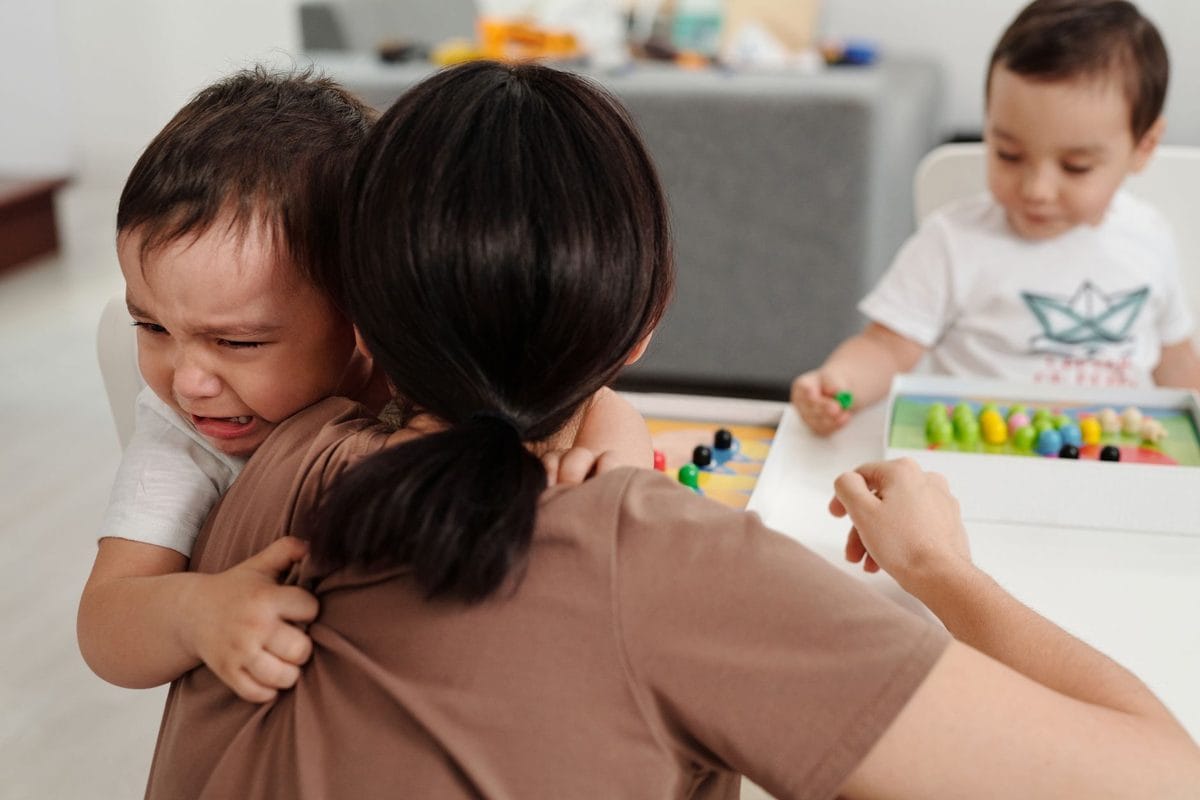
The Switch Flips Around Week Two, Not Day One
Your five-year-old was dressing himself without a fight two weeks ago. Now he wants you to put his socks on, he's talking in a baby voice at the dinner table, and last night he wet the bed for the first time since he was three. You didn't change the routine, and nobody in the house is sick. School did this — but not on day one, which is exactly why it catches parents off guard. The meltdown on the first morning is expected and mostly forgotten by lunchtime. Ten or fourteen days later, though, once the adrenaline of "new" has worn off and the accumulated tiredness of a longer day, a stricter schedule, and a room full of unfamiliar faces has had time to settle in, the regression that shows up next is the one nobody warned you about.
This Has a Name, and Pediatricians See It Constantly
Dr. Tisa Johnson-Hooper, a pediatrician at Henry Ford Health, describes regression as a coping signal rather than a step backward: whenever a child regresses, she tells parents to look for a stressor, and that stressor doesn't have to be dramatic — a sibling starting kindergarten counts, and so does a switch from a home-based caregiver to a full classroom. She also notes there's no fixed age when this starts; she's seen it in children as young as nine months. The behavior isn't the problem. It's the message.
It isn't manipulation.
A child who suddenly can't fall asleep without you in the room, or who reverts to pointing and grunting instead of using the sentences she had last spring, is doing the only thing available to a brain that hasn't finished building the vocabulary for "I'm overwhelmed and I don't know how to say that." Toddlers and even early-elementary kids are still years away from being able to name a feeling like insecurity or jealousy on the spot, so when the feeling is bigger than the words, the body takes over — through a tantrum, a clenched fist, or a sudden reappearance of the thumb in the mouth. Speech-language pathologists see a milder version of this constantly in the first month of a new school year: a child who was speaking in full sentences at home in July answers questions with single words or gestures at pickup, not because the skill disappeared but because holding a conversation takes bandwidth that's already spoken for. The same goes for physical skills — a kid who could climb the stairs unassisted might ask to be carried, not out of laziness but because the muscles doing the "holding it together" work all day are the same ones that run out of patience for anything extra by four in the afternoon. None of this shows up on a report card or a pediatric growth chart, which is part of why it blindsides parents; there's no official marker for "used up his coping capacity by lunchtime." It's also why the same child can look perfectly composed at school and fall apart the moment the car door closes — the classroom is where the effort goes, and home is where it's safe to stop pretending.
What Regression Actually Looks Like, Age by Age
The exact shape of it depends heavily on where a child was developmentally before school started, so a checklist only gets you so far. Still, a few patterns show up often enough to be worth naming, and knowing them ahead of time takes the edge off when they arrive.
- Preschoolers (roughly 3–5): bedwetting after months or years of being dry, wanting to be carried instead of walking, asking for help with buttons and zippers they'd mastered, or a sudden fear of the dark that wasn't there before.
- Kindergarten and early elementary (5–8): whining that seems disproportionate to the trigger, resistance to getting dressed or leaving the house in the morning, and emotional outbursts in the evening that look like they came from nowhere but are almost always the delayed release of a day spent holding it together in front of a teacher and twenty classmates.
- Across both age bands: baby talk, wanting a bottle or pacifier that was retired months earlier, or clinginess that shows up specifically with one parent and not the other.
None of that is a complete list, and plenty of kids will invent a version that doesn't match any bullet point exactly.
The Sleep-Mood Loop Makes It Worse Before It Gets Better
Here's where it compounds. A child who's anxious about the new classroom often sleeps worse, whether that means trouble falling asleep, more nightmares, or waking at 5 a.m. because their nervous system is still on alert. From there, worse sleep produces a crankier, less regulated kid the next day, which produces bigger tantrums and more resistance at drop-off, which produces more parental stress at exactly the moment patience is already running thin — and then that tension bleeds back into bedtime, restarting the cycle. Most families can break this loop within two to three weeks simply by holding the line on a slightly earlier bedtime and not adding new stressors during that window, even ones that seem small, like starting a new after-school activity in the same month.
Not every case fits this pattern, though. Some regression has nothing to do with school stress at all — it overlaps with an unrelated developmental leap, a molar coming in, or a family change like a move or a new baby that happened to land in the same season, and treating every wobble as a school-anxiety symptom can lead parents to over-manage something that would have resolved on its own regardless of the calendar.
One Sibling Sails Through, One Doesn't — Both Are Normal
Parents with more than one child in the house often notice the regression lands on only one kid, and it's rarely the one they expected. The oldest, who's "done this before," can be hit harder than the younger sibling starting fresh, because an older child carries more memory of last year's easier routine and feels the loss of it more sharply. Temperament plays a bigger role than birth order or age gap: a naturally cautious kid who takes weeks to warm up to a new babysitter will almost always take longer to settle into a new classroom than a sibling who introduces himself to strangers at the grocery store. None of that means the more resilient child is fine and the other is broken — it means their nervous systems process novelty on different timelines, and comparing them out loud, even gently, tends to make the slower-adjusting one feel worse rather than motivated.
This is also where a lot of well-meaning advice from other parents backfires. A friend whose daughter "adjusted in three days" isn't lying, and her advice isn't wrong for her kid — it just doesn't transfer. Two children in the same classroom, same teacher, same schedule, can have completely different regression timelines because regression tracks a child's internal stress load, not the objective size of the transition. A parent chasing someone else's three-day timeline usually ends up more anxious than the child does, and that anxiety has a way of leaking into morning drop-offs regardless of how calm the voice sounds.
What Actually Helps
Ignore the regressed behavior itself rather than commenting on it, correcting it, or negotiating with it — a four-year-old who starts sucking his thumb while being held gets set down gently and redirected, without a lecture about being a big kid now. Reacting strongly, even with frustration, gives the behavior exactly the attention it's designed to pull, and attention of any kind reinforces it. The better move is to name the underlying feeling instead of the surface behavior: "New places are a lot. It makes sense you want to be close to me right now" does more work than "You know how to walk, you don't need to be carried."
Protect the twenty minutes before bed like it's non-negotiable, even on nights when homework or dinner ran late. A short, predictable wind-down — the same book, the same two songs, lights out at roughly the same time — gives an unsettled nervous system the one part of the day it can count on. Skip the pep talks about how "tomorrow will be better." Kids in this state don't need reassurance about the future; they need proof, repeated nightly, that at least one part of their world hasn't changed.
When Regression Signals Something More Than Stress
Most of this resolves within four to six weeks without any intervention beyond patience and a stable routine. Johnson-Hooper's guidance is to bring it to a pediatrician when the regression is intense, when it persists well past that window, or when it comes with something physical — fever, pain, a rash, or a real loss of a skill the child had clearly mastered rather than an inconsistent one they're wobbling on. A kid who occasionally reverts to easier words under stress is different from one who has genuinely stopped using sentences she used fluently in June; the first is adjustment, the second is worth a call.
By the time October arrives, most of what showed up in September will have quietly disappeared — the bedwetting stops, the baby talk fades, the socks go back on unassisted. The kids who needed help with buttons at drop-off in week three are usually the same ones racing ahead without a backward glance by the time the leaves turn, and they won't remember any of it. You will.