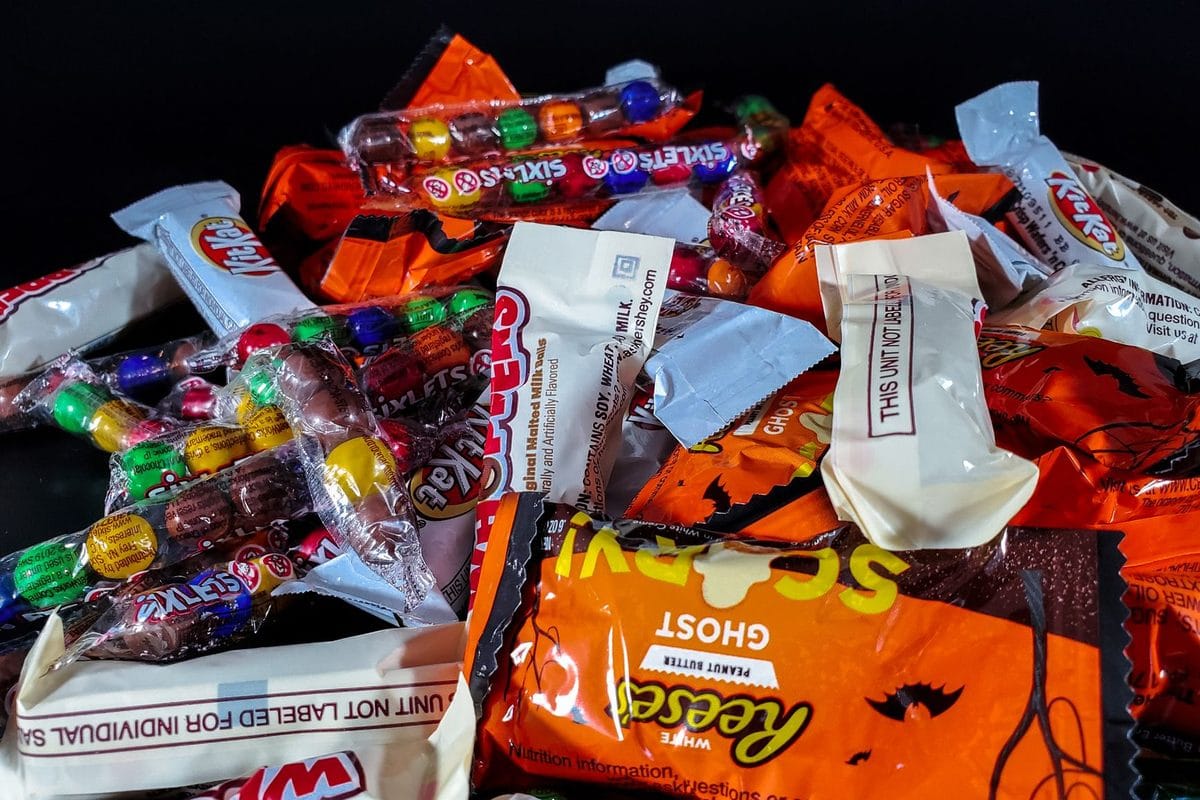
It's 8:40 on Halloween night, and the pillowcase has just been tipped out across the living room rug. Within ninety seconds the haggling starts: three pieces tonight, no, five, and why does his pile have more of the good kind. If nobody has agreed on candy rules ahead of time, you'll be inventing them on the spot, with a tired kid, a doorbell that's still ringing, and a bedtime that slipped an hour ago.
This year Halloween falls on Saturday, October 31, so there's no school the next morning, and you have about three weeks to decide what the rules are. Settle them now, while nobody is holding a fun-size anything.
Dinner Is the Part of the Night You Fully Control
A real dinner before you leave the house does more than any candy rule you'll make afterward.
The American Academy of Pediatrics recommends giving kids a good meal before trick-or-treating, specifically to discourage sampling along the route, and the logic is hard to argue with. A child who has eaten pasta and a side of something green is far less likely to unwrap a third lollipop on a stranger's driveway. Serve it at the normal time even if everyone ends up eating in half a costume. If trick-or-treating in your town doesn't start until after dark, the AAP also suggests checking with your town or park district for earlier events, which makes it easier to hold to the usual bedtime. Sorting the haul belongs at home too: wait until your child is back to look through everything, because tampering is rare but it can happen, and the check takes five minutes. Throw out anything spoiled, unwrapped or suspicious, and let the rest go into the pile.
One more rule belongs at the front door. The AAP notes that child pedestrian injuries are more likely on Halloween than on any other night of the year, and motorists can have a hard time seeing trick-or-treaters, so don't assume a car will stop just because your kid has the right of way. Young children go with an adult, always. Older kids can go in a group once you've agreed on the route and a time to be home, and everyone carries a flashlight after dark, stays on the sidewalk and crosses at crosswalks instead of between parked cars.
Two Days of Free Candy, Then a Boring Rule
Ellyn Satter, the dietitian and family therapist behind the Division of Responsibility in Feeding, has a candy plan that sounds reckless until you read her reasoning. Her framework gives the parent the what, when and where of meals and snacks, and leaves the child to decide whether and how much. When your child gets home, let them dump out the haul, gloat over it, sort it into piles and eat as much as they want. Let them do the same the next day. Then the candy gets put away and moves to meal- and snack-time: a couple of small pieces with meals as dessert, and as much as they like at the sit-down snack. As long as your child can stick to that, the stash stays theirs, and if they can't, you hold it until they can. Satter's argument is that children who have regular access to sweets tend to eat them moderately, while children who are kept away from them load up when they aren't even hungry, and then beg, whine and sneak. She adds one small detail that's easy to miss, which is to pour a glass of milk to go with the candy.
The AAP takes a different route: ration the treats across the days and weeks after Halloween, keep the rules realistic, consistent and positive, and make the plan together so everyone knows what to expect. The two approaches aren't opposites, since both want the rules settled before the bag fills up and neither wants candy to become a nightly negotiation. The real difference is the first 48 hours. For a school-age child, use Satter's two-day plan, because it takes the forbidden-fruit glow off the pile faster than any speech will.
The catch is that it asks a lot of you. Watching a seven-year-old eat eleven pieces in a row takes nerves, some kids will end Saturday night with a stomachache, and a kid who's used to tight limits may eat ravenously at first, which is exactly what Satter's reasoning predicts. If you can't stand it, the AAP's slower version is a perfectly good plan, as long as it's the same plan every night rather than a new ruling each evening. Either way, say the rule out loud in the car before you head out: tonight and tomorrow it's all yours, after that it lives in the kitchen cabinet.
What One Small Bag Adds Up To
The American Heart Association recommends that children ages 2 to 18 get less than 25 grams of added sugar a day, about 6 teaspoons. The label on a fun-size Snickers lists a 17-gram bar with 80 calories and 9 grams of sugar, 8 of them added, so three bars land at 24 grams. That is a whole day's guideline gone before a bowl of cereal, a flavored yogurt or a juice box has been counted. It doesn't make Halloween night a problem, since the guideline is a daily number and a holiday is a holiday, but it does explain why "just a few more" from a full pillowcase drains fast, and why a stash left in a bedroom can stretch a one-night event into a three-week one.
The sugar-and-behavior part of the story is shakier than most of us assume. A 1995 meta-analysis in JAMA pooled 23 double-blind studies in which children received either sugar or an artificial-sweetener placebo, and it found that sugar did not affect their behavior or cognitive performance. The authors suggested that parents' strong belief in a sugar effect may come from expectation and association, though they added that a small effect, or effects in subsets of children, could not be ruled out. So before you blame the candy for the 9 p.m. meltdown, look at the other suspects: a bedtime that slipped, a costume that itches and a dinner somebody skipped.
Toddlers Get a Different Pile
Babies and toddlers need their own rulebook, and the AAP spells it out: no hard candies, caramel apples, popcorn, gum, small candies such as jellybeans, gummy candy, pumpkin seeds or anything with whole nuts. Wrappers, stickers, small toys and temporary tattoos are choking hazards too, so keep an eye on what's in your child's mouth the whole time you're out. For a child under 2, the American Heart Association recommends no added sugar at all, which settles what happens to their share of the candy. With a 3-year-old, you hold the stash, which is the fallback Satter describes anyway, and you hand over one piece at snack-time. Sort the haul after bedtime, pull everything on the AAP's list, and nobody under four ever has to know it existed.
Halloween With a Food Allergy, Yours or the Neighbor's
The AAP calls Halloween one of the trickiest days of the year for children with food allergies, in part because even a candy that doesn't list the allergen can cause anaphylaxis if it was made in a facility that uses that allergen in another product. If your child has an allergy, the prescribed epinephrine auto-injector or nasal spray goes in the bag, every adult on the route knows when and how to use it, and nothing gets eaten until you've read its label at home. A piece with no label doesn't get eaten.
The easiest way to help other people's kids is to put a bowl of non-food treats on your own porch. That's the idea behind the Teal Pumpkin Project, which began with an East Tennessee family: Becky Basalone, whose son has a severe food allergy, wanted him to trick-or-treat without having to refuse candy at every door. Her family offered non-food treats and set a teal-painted pumpkin outside as the signal, and Food Allergy Research & Education (FARE) took the idea national in 2014. In 2024 FARE's map listed more than 12,500 locations, with participants in all 50 states and Washington, D.C. The AAP's list of non-edible treats is long: glow sticks, spider rings, vampire fangs, pencils, bubbles, bouncy balls, whistles and stickers, among others. Keep them in a separate bowl from the candy, put a teal pumpkin or one of FARE's free printable signs out front, and add your address to FARE's map if you want families to be able to plan a route.
Where the Leftover Candy Goes
Once the two days are up, a stash shrinks faster when some of it has somewhere to go. Let each kid pick a small jar's worth of keepers, and let the rest leave the house. Some dental offices run swap events that trade candy for toothbrushes, stickers or small toys, although each dentist sets their own rules and there is no longer a national directory, so you'll have to call your own. Soldiers' Angels runs a Treats for Troops drive with a drop-off map on its website, and Troopathon's Halloween Candy Buyback collects candy for care packages and suggests shipping between November 1 and 7. Operation Gratitude, which used to be the default answer, no longer accepts candy. Check each program's current instructions before you box anything up, and call a local food pantry or shelter before you show up with a bag.
Keep the keeper jar somewhere you can see it, pour the milk when the candy comes out, and let the whole thing be boring. A stash that's still half full at Thanksgiving means the plan worked.