Somebody's cousin is manning the grill, somebody's uncle is refilling the cooler, and for roughly ninety seconds — the exact stretch it takes to answer a phone call about parking — nobody is actually watching the shallow end. That gap is where most child drownings happen. Not in a dramatic rip current, not on some once-a-year ocean trip, but in a backyard pool, a lake dock, or a bathtub, during a window of time short enough that everyone in the yard assumed somebody else had eyes on the water. Nobody decided to stop watching. The watching just quietly moved from one adult to a group of adults, which in practice means it moved to no one.
The Number Most Parents Have Never Actually Seen
According to the Centers for Disease Control and Prevention, drowning is the leading cause of unintentional death for children between the ages of one and four in the United States, and it stays in the top three causes of accidental death for kids up through age fourteen. Roughly 4,000 fatal unintentional drownings happen across the country every year — an average of about eleven a day, every single day, not just in July. For children under five specifically, most of those deaths don't happen at the beach or the lake. They happen in home swimming pools, often within a few yards of a house full of people, often during a family gathering rather than a lone afternoon at the pool. That detail matters more than the raw number does, because it means the highest-risk moment for a toddler with pool access isn't a random Tuesday. It's the birthday party, the Fourth of July cookout, the weekend when three families are over and the pool has never had more people supervising it and, somehow, less real supervision.
Layers, Not One Line of Defense
Water-safety researchers talk about "layers of protection" for a reason: no single measure, on its own, reliably stops a determined two-year-old from reaching a pool. Stack several imperfect barriers and the gaps in each one stop lining up. In practice, for a family with pool access, that stack usually looks something like this:
- A four-sided fence that fully separates the pool from the house and yard — self-closing, self-latching, built to the ASTM F2286 standard many U.S. states already require for new pools
- A door alarm on any exterior door that leads toward the water, so a toddler slipping outside during a nap-time gap doesn't go unnoticed
- A pool alarm that detects surface disturbance, which is a genuinely useful backup but has enough false alarms and missed detections that it should never be the only layer
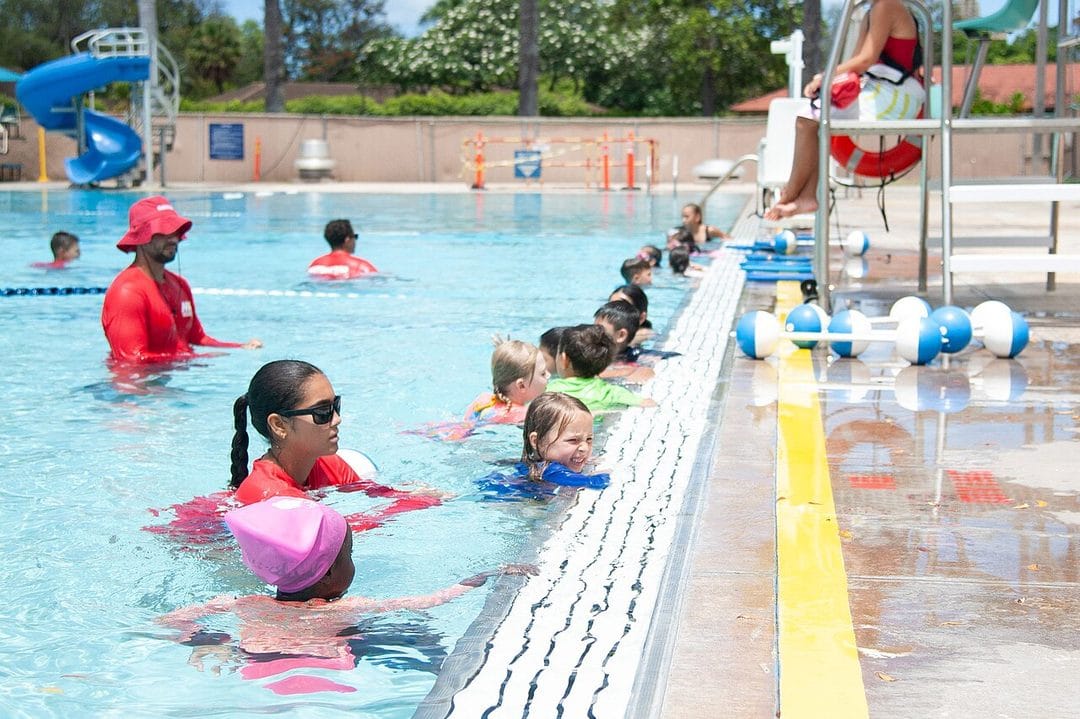
- Swim lessons, starting as early as a pediatrician recommends for your child's age and comfort level
- At least one adult, at all times, whose only job in that moment is watching the water — not the grill, not the group text, not the older sibling who "should be fine for a second"
A fence with a gate that gets propped open for the length of a barbecue isn't a fence. It's a suggestion, and toddlers don't read suggestions.
What Swim Lessons Actually Buy You
Group lessons through a YMCA or a community pool typically run somewhere between $10 and $25 per session and are genuinely useful for building comfort in water, breath control, and basic strokes from around age three or four onward. For a toddler who already has pool access at home, though, a structured infant/toddler self-rescue program — Infant Swimming Resource (ISR) is the best-known example, usually priced around $100 to $200 for a week of short daily sessions — teaches something different and more specific: rolling onto the back and floating to breathe if a child ends up in water unexpectedly, fully clothed, with no adult in reach. If you have a pool, a pond, or even a hot tub at home and your child is under three, enroll them in a self-rescue program before you enroll them in general swim lessons. General lessons are fine and worth doing later, but they're built around a child who's already expecting to be in the water, not one who's just fallen in.
None of this makes a toddler "water safe," a phrase that shows up on more swim-school marketing than it should. Lessons measurably reduce drowning risk in kids aged one to four — several published studies put the reduction in the range of 88 percent when comparing children with formal instruction against those without — but reduction isn't elimination, and a four-year-old with six weeks of lessons under her belt can still get into serious trouble in twenty seconds if nobody's watching. Treat the certificate as one layer among several, not as the finish line.
The Job Nobody Actually Assigns at the Pool Party
Somebody has to drown for this to become obvious in hindsight.
The American Red Cross's "Water Watcher" concept exists precisely because everybody assumes somebody else has the job. At any gathering with more than two or three adults and a pool, name one person — out loud, with a physical object changing hands, a lanyard, a card, a beach towel draped over a shoulder — whose only responsibility for the next fifteen or twenty minutes is watching the water. No phone in hand, no drink to refill, no side conversation pulling their eyes off the surface — just the water, for those fifteen minutes. When that block of time ends, they hand the card to the next adult and say so, the way a lifeguard physically clocks in and out of a chair. It feels a little theatrical at a backyard party. It works precisely because it removes the ambiguity that gets kids killed — the assumption that supervision is happening because there are plenty of grown-ups around.
Reading the Water Like Someone Who's Seen a Close Call
Drowning almost never looks like the movies. There's no waving, no shouting, no dramatic splash that draws every head in the yard. Physiologist Frank Pia's research on the instinctive drowning response describes something quieter and more physically involuntary: a child's mouth barely at water level, head tipped back, arms pressing down against the surface rather than waving for help, legs no longer kicking, eyes glassy or closed, hair often plastered over the forehead. A struggling swimmer's body is doing everything it can just to get one more breath — there's no spare effort left for a shout. If a kid who was just playing loudly suddenly goes quiet in the pool, treat the quiet as the warning sign, not the reassurance. Silence in water is not calm. It's usually the opposite.
The After-the-Pool Conversation Nobody Wants to Have
"Dry drowning" and "secondary drowning" are terms that circulate constantly on parenting forums and almost never appear in current medical literature the way people use them — pediatric emergency physicians have pushed back on the phrasing for years because it implies a mysterious, delayed death with no warning signs, which isn't how the actual physiology works. What is real: a child who inhales water during a scare — a real submersion, a real coughing-and-panic moment, not just an ordinary splash to the face — can develop breathing difficulty in the hours afterward as the airway reacts to that water. If your child has a genuine submersion scare and afterward shows persistent coughing, unusual sleepiness, chest pain, or real difficulty breathing, that's an emergency-room visit that evening, not a wait-and-see. A kid who coughed once, laughed it off, and went back to cannonballing off the steps doesn't need one.
Get CPR certified — infant and child CPR specifically, through the American Red Cross or the American Heart Association, both of which run in-person classes lasting three to four hours for around $50 to $95. If you own a pool, this isn't optional homework for "someday." The gap between a submersion and permanent brain injury is measured in single minutes, and the person closest to the water when it happens is far more often a parent or grandparent than a paramedic, who's still five or ten minutes away no matter how fast the call gets made.
The pool fence, the swim lessons, the water-watcher card changing hands at the party, the CPR class you keep meaning to book — none of it is dramatic, and none of it makes for a good Instagram caption. It's the boring, repeated, slightly annoying stuff that actually works, and it works this weekend, at the next backyard gathering, not hypothetically next summer once somebody's had a scare that finally makes it feel real.