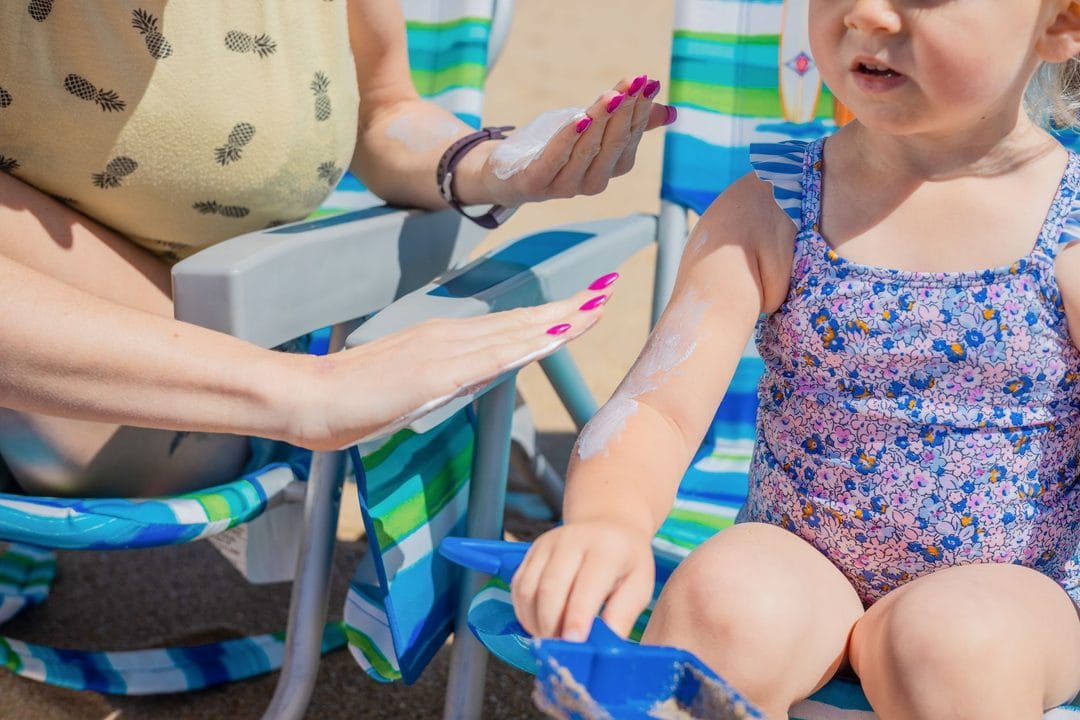
Before you had children, hot weather was straightforward. You went outside, you maybe slapped on some sun cream if you remembered, you came back in when you got too warm. Now there's a small person involved, possibly more than one, and a genuinely sunny week turns into a low-grade logistics operation: the cream, the hats that get flung off, the timing of naps so nobody melts down at the splash park, the constant low worry about whether they've had enough water. It's a lot, and almost no one warns you about it.
The thing is, kids really are more vulnerable to heat and sun than we are, and not by a little. Their skin is thinner and burns faster, they overheat more quickly because their bodies regulate temperature less efficiently, and the youngest ones can't tell you they're too hot or thirsty. So the management isn't fussing. It's the actual job of a hot-weather day. Here's how to do it without it swallowing the whole summer.
Sun cream, and why most of us use it wrong
Two mistakes dominate. The first is using far too little. The guidance most dermatologists give is roughly a teaspoon of cream per limb and the same for the face and neck, which is dramatically more than the cautious smear most of us apply to a wriggling toddler. Under-applying SPF 50 effectively turns it into a much weaker number. The second mistake is treating it as a once-a-day job. It needs reapplying every two hours, and immediately after swimming or heavy sweating, even the "water resistant" ones.
For babies under six months, the official advice is different and worth knowing: keep them out of direct sun altogether rather than relying on cream, because their skin is too delicate. Shade, clothing and a pram cover that actually lets air move are the tools there, not a bottle of SPF. For everyone older, a sensitive-skin SPF 50 from a brand like Childs Farm, Altruist or Garnier Ambre Solaire Kids does the job for £4 to £12, and the expensive ones aren't meaningfully better than the cheap ones as long as the number is high and you actually use enough.
The shade-and-timing game matters more than the cream
Here's the part that genuinely lightens the load once it clicks: the best sun protection isn't a product, it's the clock. UV in the UK and across most of Europe peaks roughly between 11am and 3pm. If you shift the big outdoor stuff, the park, the beach, the long walk, to before eleven or after three, you sidestep the worst of it entirely and the cream becomes a backup rather than the whole defence.
That midday window is perfect for the things that needed doing anyway:
- Lunch somewhere shady, then the youngest one's nap.
- A cool indoor activity, even if it's just the floor, some water play in the kitchen, and a fan.
- The library, a soft-play, or anywhere with air conditioning if the heat is serious.
- And occasionally, on the worst days, the telly, with zero guilt, because a calm child indoors at one o'clock beats a scorched one at the playground.
Wide-brimmed hats genuinely work, and the legionnaire-style ones with a neck flap that toddlers can't easily fling off are worth the slightly silly look. A UV-protective swim suit, the long-sleeved kind, is the single best buy for beach and pool days because it removes whole limbs from the cream rota. Decathlon and M&S both do them from around £10.
Spotting overheating before it becomes a problem
This is the bit that quietly worries every parent, so it's worth being concrete. A child who's overheating may go quiet and floppy rather than loud and upset, which is the opposite of what you'd expect and easy to miss. Flushed skin, being unusually grumpy or sleepy, fewer wet nappies, and a dry mouth are the signs to watch. The fix is usually simple and fast: get them into shade or somewhere cool, offer fluids, take layers off, and a cool damp flannel on the back of the neck works wonders.
Water is the constant. Small children won't reliably ask for it, so you offer it far more often than feels necessary, and for breastfed babies under six months that means more frequent feeds rather than water. A frozen-fruit lolly or watermelon counts toward hydration and buys you cooperation, which on a hot afternoon is not nothing.
One honest caveat: you will not get this perfect, and that's fine. Some days the cream wears off before you reapply, the hat ends up in a bin, and everyone gets a bit pink despite your best efforts. A single mild flush of colour is a learning moment, not a failure. The goal isn't a flawless force field around your child all summer. It's avoiding the genuine burns and the heat-exhaustion afternoons, and that's entirely doable with shade, timing, water, and enough cream actually rubbed in. The rest is just summer.