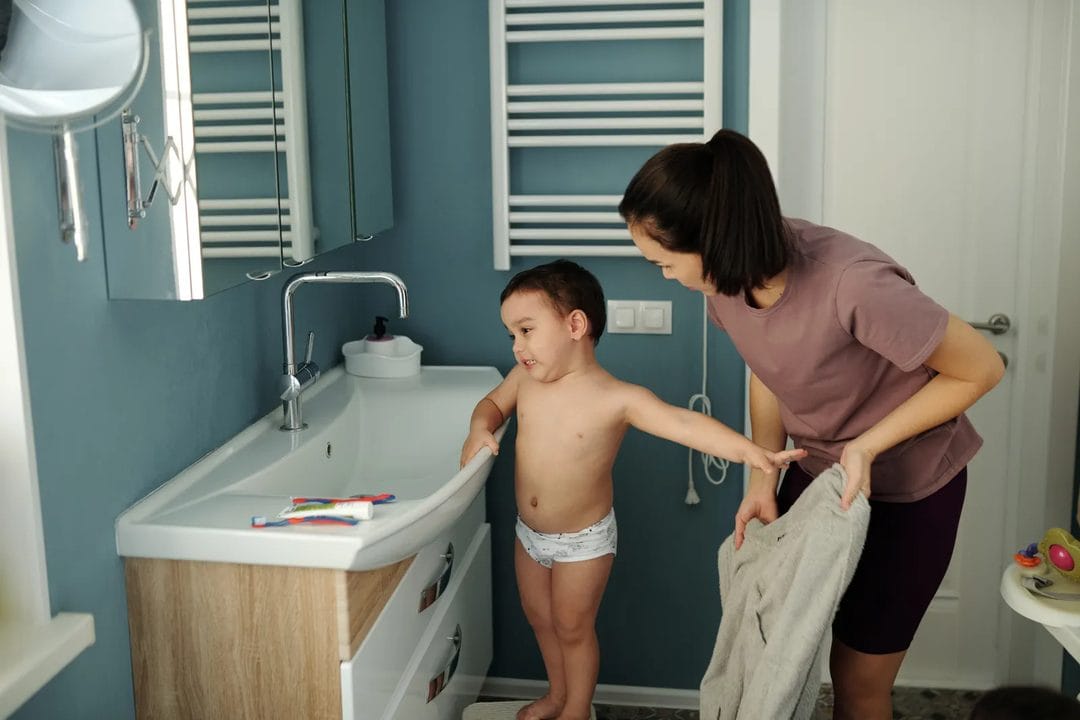
Somewhere around day three, when your toddler is standing frozen in the middle of the living room clamping their legs together and insisting they "don't need to go," you'll start to suspect that the parenting books promising a 72-hour finish line were written by someone who has never actually met a toddler. Potty training is one of those milestones every parent expects to check off a list, and then it turns into a six-month negotiation with a very small, very stubborn person who has full control of the one thing you can't force. The good news: most kids get there. The timeline just rarely looks like the chart taped to the pediatrician's wall.
The Age Question Nobody Answers Straight
Ask five different sources when to start potty training and you'll get five different answers, ranging from 18 months to "whenever they're ready, don't rush it." In practice, most children in the US show physical readiness signs — staying dry for two or more hours, noticing when their diaper is wet, being able to walk to and sit on a potty — somewhere between 22 and 30 months. That's readiness, though, not completion. The average age for finishing daytime training, meaning consistently using the toilet without reminders, tends to land closer to 32 to 36 months, and plenty of perfectly typical kids don't get there until closer to four. If your child is 2 and a half and still in diapers, you're not behind. You're roughly on schedule for a huge share of families, no matter what the parent three houses down is posting about their 20-month-old "graduating." Boys, on average, tend to finish daytime training a few months later than girls, which has more to do with bladder maturation timing than with anything you're doing right or wrong.
Readiness Signs Worth Watching For
- Staying dry for stretches of 90 minutes to two hours during the day
- Telling you (in words, gestures, or by hiding behind the couch) that they're going
- Showing interest in the bathroom — wanting to flush, watching you, asking questions
- Being able to pull pants up and down mostly on their own, even if you finish the job
- Following two-step instructions without a meltdown most of the time, which matters more than people expect
What Actually Works in the First Week
The "3-day method" that circulates on parenting forums — bare bottom, juice, and a potty parked in the kitchen for 72 hours straight — works well for some kids and is a disaster for others, and there's no reliable way to know in advance which camp your child falls into. It tends to work best for kids who are already showing strong readiness signs and who respond well to intensity and novelty. For a more cautious or sensory-sensitive kid, that same weekend can turn into a standoff that sets training back by a month. Skip the marathon approach if your child gets overwhelmed easily; a slower two-week runway with short, low-pressure potty sits after meals tends to land better for that temperament, and there's no prize for finishing fast.
Buy the potty chair before you need it, not the week you plan to start. A basic seat like the BabyBjörn Potty Chair or the cheaper Munchkin version runs $15 to $35, and letting your child sit on it fully clothed for a few days beforehand — reading books, watching a show, whatever gets them comfortable — removes a layer of resistance later. Underwear shopping matters too. Buy at least 10 to 15 pairs, because you will go through more in a single afternoon than seems reasonable, and cheap multipacks from Target or Amazon (usually $12 to $18 for a dozen) are fine; this is not the place to spend money on character branding your kid will outgrow interest in within a month. Skip pull-ups during active daytime training if you can manage it. They feel too much like a diaper, and a lot of kids read that as permission to treat them like one.
Nighttime Is a Completely Different Skill
Staying dry overnight depends on bladder capacity and a hormone called ADH that concentrates urine while you sleep, and neither of those develops on the same timeline as daytime bladder control. Most pediatric guidance treats nighttime wetting as developmentally normal up to age 7, which surprises a lot of parents who assumed daytime and nighttime training would happen together. They usually don't. It's common for a child to be fully daytime trained for a year or more before nights catch up, and pushing nighttime training before a kid's body is physiologically ready — no matter how motivated they are — mostly just produces frustrated 4 a.m. wake-ups for everyone in the house.
Keep pull-ups or a product like GoodNites for nighttime long after daytime underwear is settled, and don't treat that as a step backward. A waterproof mattress protector (around $20 to $30) saves you from stripping the bed at 2 a.m., which you will otherwise do more than once. If nighttime dryness hasn't clicked by age 6 or 7 and it's affecting your child's confidence — sleepovers, camp, that kind of thing — that's a reasonable moment to bring it up with a pediatrician, not before.
When It Stalls, and It Will
Almost nobody's kid goes from diapers to fully trained in a straight, unbroken line.
Here's the part nobody puts in the initial pep talk: almost every kid plateaus at some point, usually right around the two- or three-week mark, after the initial novelty wears off and before the habit is fully automatic. Accidents that had dropped to nearly zero start creeping back up. Your child, who was announcing every bathroom trip with pride last week, suddenly seems to have forgotten the entire system exists. This is not regression in the clinical sense — it's the ordinary bumpy middle of learning a new skill, and it responds to patience far better than it responds to pressure.
What actually moves things forward at the stall point is usually smaller than parents expect. Go back to scheduled potty sits every 60 to 90 minutes even if your child insists they don't need to, because the whole point is catching the window before the urge becomes urgent. Stop asking "do you need to go?" — a question that invites an automatic no from basically every toddler on earth — and switch to a flat statement: "Let's go try." Drop any sticker chart or reward system that's turned into a source of daily disappointment; for some kids it motivates beautifully, and for others it just adds a layer of failure on top of an accident that already felt bad enough. Watch for a specific trigger, too. A new sibling, a move, starting daycare, or even a cold that makes a child less aware of body signals can knock training sideways for a week or two, and once that disruption passes, most kids snap back on their own without any change in approach. Constipation is worth ruling out here too, since a child who's holding stool tends to hold urine along with it out of the same physical discomfort.
Real Regression vs. a Rough Patch
A rough patch looks like inconsistency — good days and bad days, mostly tied to distraction or overexcitement. Genuine regression looks different: a child who was reliably dry for weeks suddenly having daily accidents, showing new anxiety around the bathroom, or developing physical symptoms like straining or complaining it hurts to go. That combination is worth a call to the pediatrician, since it can point to constipation (extremely common and very treatable) or occasionally a urinary tract infection rather than a behavioral stall.
Public Bathrooms, Daycare, and the Logistics Piece
Nobody warns you how much of potty training happens outside your own bathroom. Automatic flush toilets terrify a surprising number of toddlers — the sound is loud and the timing is unpredictable — and a sticky note over the sensor or a hand pressed firmly over it during the sit solves this more often than you'd think. Pack a small kit for the diaper bag: a spare set of clothes, two extra pairs of underwear, plastic bags for the inevitable mess, and flushable wipes, and keep it stocked even after you think you're past the accident-prone stage, because you are not, not for a while yet.
Coordinate with daycare or preschool before you start, not after. Most centers run on a group schedule with set bathroom times, which is actually helpful — consistency between home and daycare speeds things up — but you need their staff on the same page about your child's cues and vocabulary before day one, or you'll get mixed signals working against each other. Ask specifically what happens with accidents at daycare, since policies vary widely: some centers handle it without comment, others require a certain number of consecutive dry days before dropping diapers during nap, which can catch parents off guard if nobody mentions it upfront.
None of this moves in a straight line, and the kid who was dry for three weeks straight in March can still show up in April having what looks like a total reset. That's not a sign you did something wrong. It's just what this particular skill looks like on its way to becoming permanent.