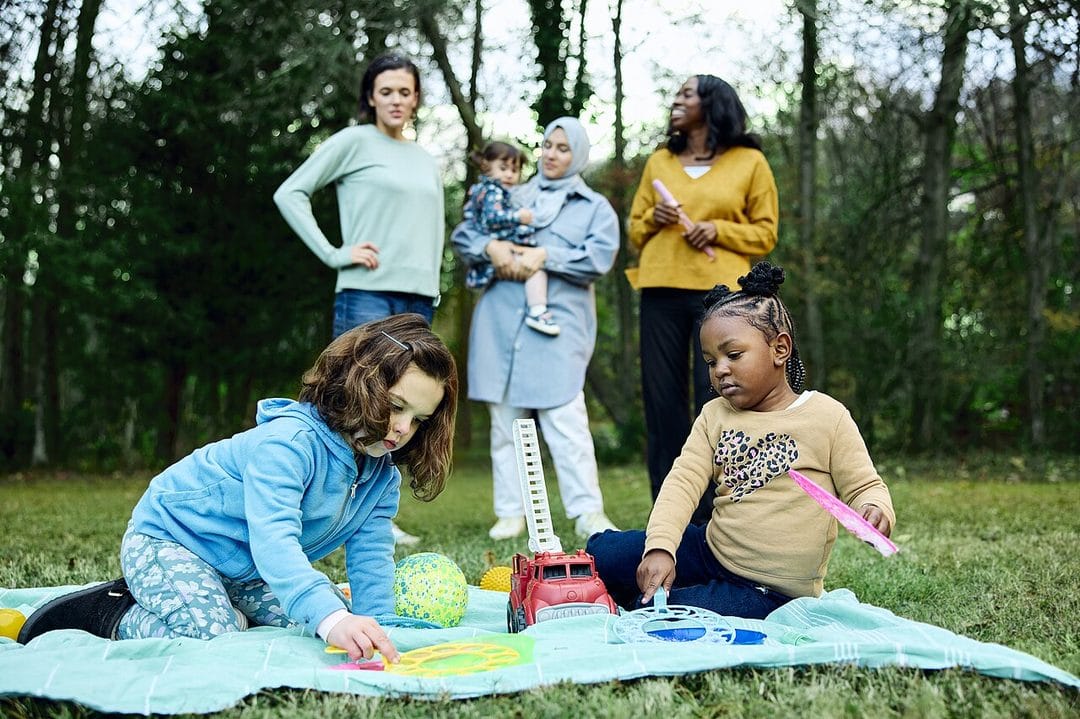
You're standing at pickup, phone in your hand, and there's nobody to text. It's not that your contacts list is empty — it's that the people in it knew you from a different version of your life, the one that ran on last-minute dinners and Saturday nights that didn't require a babysitter and a spreadsheet. None of them are awake at 6:45 on a Tuesday, wrangling a toddler into a car seat. The women around you at the gate are the ones who'd actually get it. You just don't know their names yet.
Nobody prepares you for this part. The books cover sleep training, feeding schedules, the slow crawl back to work. Nobody sits you down and says that the friendships you spent fifteen or twenty years building are about to get quietly reshuffled — some permanently — and that making new ones now will take more deliberate effort than anything you did in your twenties, when proximity did most of the work for you.
Why old friendships get harder to keep
Friendship in your twenties runs on repeated, unplanned contact: the same office, the same gym class, the same group chat making plans for Friday because everyone's calendar was basically empty. That mechanism doesn't survive a baby. And it's not because your college roommate stopped caring about you — she probably still would drop everything if you called her crying at 2 a.m. It's that the low-stakes, no-agenda hangs that used to refill the friendship over months of small contact have nowhere left to happen. You cancel three brunches in a row because someone's teething, she stops asking the fourth time, and neither of you decided to drift apart. It just happened while you were both looking somewhere else.
This hits hardest with friends who don't have kids yet, and it hits differently again with friends whose kids are already teenagers. The childless friend can't picture why you'd cancel a dinner reservation over a 101-degree fever, and you don't have the bandwidth to explain it every time. The friend with older kids has forgotten how consuming year one actually is, or she remembers and it's the last thing she wants to relive over coffee. Neither is wrong. You're just standing in different rooms of the same house, and the walls are thicker than either of you expected.
Do the math on it, if you want the blunt version: a typical evening used to have three or four open hours after work. Now those hours are bath time, dinner, bedtime battles, and the one hour left before you collapse, which you'd rather spend unconscious than composing a text to someone you haven't seen in eight months. It's not that the friendship stopped mattering. It's that the currency you used to spend on it — spontaneous, unscheduled time — got reallocated to a person who doesn't yet know how to use a fork.
The specific kind of lonely nobody warns you about
Here's what makes new-parent loneliness different from ordinary loneliness: you're rarely alone. You might spend eleven hours a day in physical contact with another human being and still feel completely unseen by another adult. That's not a contradiction — it's the whole problem. A toddler is excellent company and a terrible conversationalist. You can go four days registering nothing but "no," "mine," and the theme song from whatever show is currently on repeat, and by day five you'll agree to a Target run alone just to hear yourself think in full sentences.
The isolation compounds if you've moved for a partner's job, if you work from home, or if you're the first in your friend group to have a baby. Postpartum support groups exist precisely because this gap is common enough to have a name in every parenting forum — "the friendship cliff" shows up on mom message boards constantly, usually posted by someone at 11 p.m. after a day with zero adult conversation. Add a colicky baby or a rough breastfeeding stretch and even leaving the house starts to feel like an event that needs planning three days out, which shrinks the pool of possible new friends to whoever happens to be at the pediatrician's waiting room on the same Tuesday you are. Partners help, but a partner coming home at 6 p.m. isn't the same as another woman who's lived through the 3 a.m. feed and knows exactly what you mean without the backstory. If that's where you are right now: it's not a personal failing, and it's not permanent, but waiting for it to fix itself usually doesn't work. It tends to take an actual decision to go looking.
Where new mom friendships actually start (not where you think)
Skip the idea that you'll meet your people at a big, generic "new moms" meetup. Those groups exist and occasionally work, but the friendships that stick tend to form somewhere with a repeat schedule and a low bar for conversation — the same library storytime every Tuesday at 10, the same stroller-fitness class at the Y, the same pickup line outside the same preschool three times a week. Repetition does the work that a one-off event can't. You don't have to make a friend in one conversation; you get to see the same face six Tuesdays running and let it build slowly, the way it used to happen in a dorm hallway.
Apps built specifically for this — Peanut is the best known, and it's been around since 2017 — solve the cold-start problem better than a general social app does, because everyone on it is there for the same reason and nobody's pretending otherwise. A "Mommy and Me" class at a local gym or a $18-a-session music class does something similar: it gives you forty-five minutes of shared context and a reason to talk before you leave. Compare that to a Facebook group with 4,000 members, where you can lurk for a year and never once end up at the same coffee shop as another human being.
Hospitals are an underused source too. Many run free or low-cost new-parent support groups in the same building where you delivered, often meeting weekly for the first six or eight weeks postpartum — and because everyone in the room has a baby within a few weeks of the same age, the ice-breaking work is already done before anyone says a word. FIT4MOM's Stroller Strides classes run in most mid-sized US cities for somewhere around $50 to $60 a month and build five minutes of chat time into every session before the workout even starts, on purpose.
Look for the smaller, recurring things, not the big ones.
A neighborhood park at the same time most mornings. A consignment sale where you end up next to the same woman every season. A single friend from your childbirth class who lives four blocks away — worth pursuing even if you didn't click instantly, because proximity plus a shared due date is doing more work than personality alone would in year one.
The awkward ask, and why it's worth it
You will have to be the one who asks. This is the part adults hate most about making friends after thirty, and having a baby doesn't exempt you from it — if anything it raises the stakes, because you're more tired and more exposed and the rejection, even a mild one, stings more than it would have at twenty-two. Ask anyway. Get her number after the second time you talk at storytime, not the fifth. Text something specific — "we're doing the splash pad Thursday morning if you want to come" — instead of the vague "we should get the kids together sometime," which everyone says and nobody follows up on.
Here's the part that doesn't get said enough: half of these friendships won't go anywhere, and that's fine. Some women you meet through your kid's daycare will turn out to have nothing in common with you beyond matching nap schedules, and forcing it past that point wastes energy you don't have. Don't hold onto a friendship with someone who makes you feel worse about your parenting choices just because she's convenient and lives nearby. The convenient friend and the real friend are sometimes the same person and sometimes not, and figuring out which is which usually only takes a few months of actually showing up.
When it doesn't click, and what to do instead
Some of this will feel forced for a while, and that's normal rather than a sign you're doing it wrong. Adult friendship studies (the most cited one, a 2018 University of Kansas study led by communication researcher Jeffrey Hall, put the number at around fifty hours of shared time before "casual friend" turns into "real friend," and roughly ninety before it becomes an actual friendship) suggest it just takes volume — repeated low-stakes contact over months, not one great conversation. That's good news, actually: it means you don't need to find the perfect mom friend at the first playdate. You need three or four decent ones and enough repeated Tuesdays to let one or two of them turn into something real.
If the playground and the preschool pickup line aren't producing anyone, widen the net past parenting spaces entirely. A running group, a book club, a church small group, a work-from-home co-working morning at a local coffee shop — these introduce you to women who happen to have kids rather than women who are only there because they have kids, and that distinction matters more than it sounds like it should. A friend who knew you before motherhood, or who met you through something unrelated to it, tends to remember there's a whole person under the diaper bag. That's not a small thing to hold onto in year one.
The friendships you build in this stretch of your life won't look like the ones from your twenties, and they're not supposed to. They'll be built out of carpool logistics and shared exhaustion and one text at 9 p.m. that just says "same," and somewhere in the middle of that ordinary, unglamorous repetition, one or two of them will turn into the kind of friend you'd call at 2 a.m. after all. You just have to show up enough Tuesdays to find out which ones.